
The question
A final table is not one game. The same hand, with the same stacks, can be a call or a fold depending on what the places pay. A payout ladder that is almost flat makes every chip worth little. A ladder that rewards first place heavily makes a chip you win worth a lot.
We took one simple spot and held everything fixed except the prize ladder: nine players, everyone with 10 BB, ante from every player. Everybody folds to the button, the button shoves all-in, the small blind folds and the big blind decides. The only thing that changes is how the prize pool is split between the nine places.
The five ladders
The numbers are the share of the prize pool that each place from first to ninth receives. We use five structures from our ICM library, plus winner-takes-all as a reference where chips are simply money.
In the very flat ladder, first place is worth only 9 points more than ninth, so a lot of the prize pool is already yours just for being at the table. In the steep ladder that gap is 44.5 points. The idea behind ICM is the same in both cases, but the two ladders pay for very different things.
What the big blind does
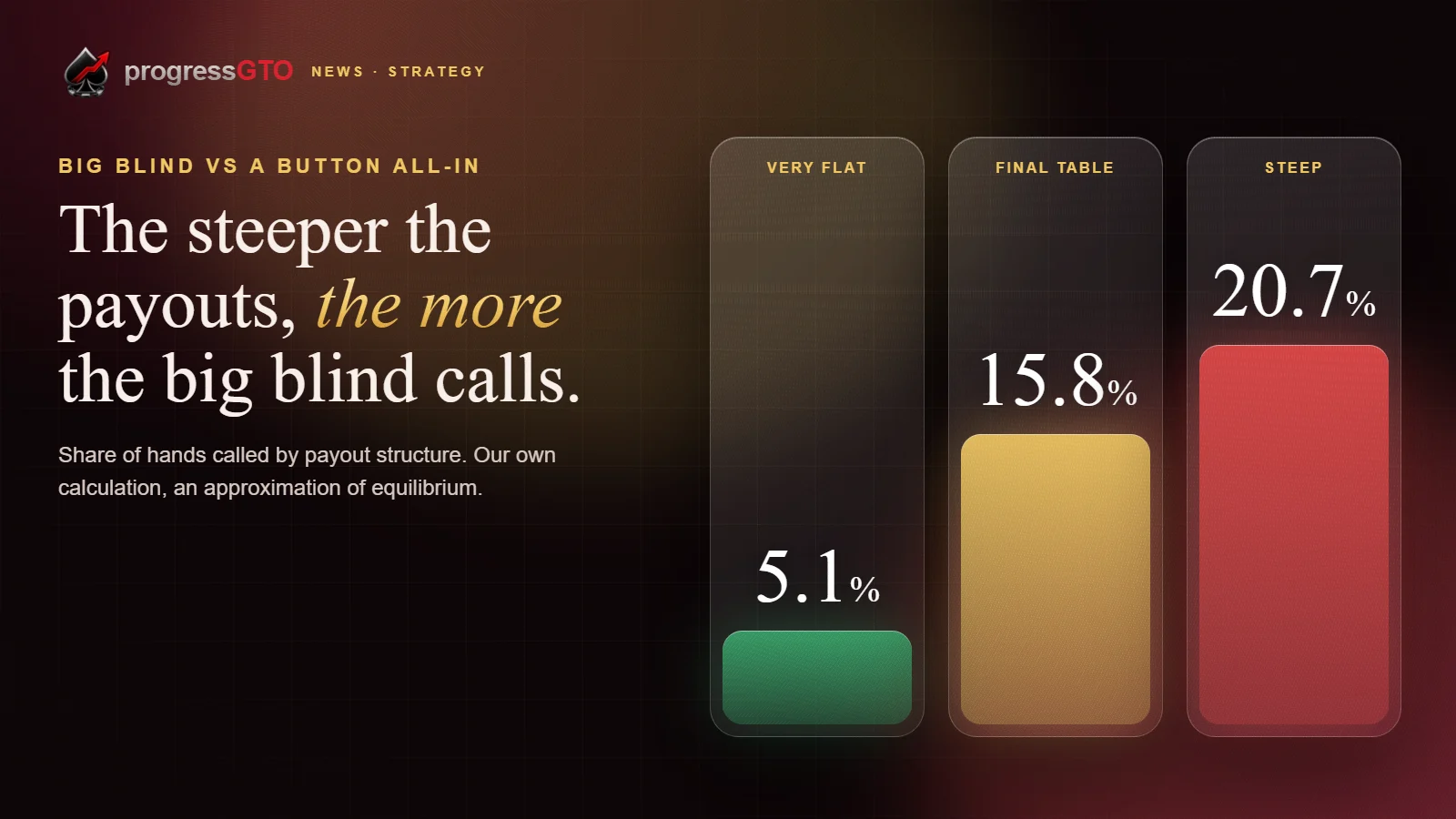
The order is clean. The flatter the ladder, the fewer hands the big blind calls with, and the steeper it is, the more it calls. Winner takes all is the limit: there chips are the only thing that matters, and the big blind calls 34.7% of hands.
Why a steep ladder calls more
A call is a gamble with your tournament life. If the big blind calls and loses, it falls from 10 BB to nothing and finishes ninth. If it wins, it doubles. In a flat ladder, ninth place already pays 7% and the double adds little, so calling risks a lot for a small reward. In a steep ladder, ninth place pays almost nothing, so there is little left to protect, and the chance to double towards first place is worth much more.
That is why the call range rises with steepness even though calling is never free. It is also why the same hand can feel like an easy fold in one tournament and a clear call in another, with exactly the same stacks.
What the button does
The button's side is less tidy. It shoves 41.6% of hands when winner takes all, 37.3% on the steep ladder, 35.4% on the final-table ladder and 36.8% on the flat one. Part of what leaves its all-in range becomes a min-raise, so its opening as a whole does not shrink as much as the all-in alone.
The very flat ladder is a special case: the button shoves 94.1% of hands, and the big blind calls only 5.1%. With such a flat prize ladder there is little to lose from a shove and little to gain from a call. It is a feature of this structure in our model and we would not read it as advice for a real tournament without checking it against your own payouts.
What these numbers do not say
Confirmed
- With nine equal 10 BB stacks the big blind calls a button all-in with 5.1%, 12.4%, 15.8%, 18.7% and 20.7% of hands on the very flat, flat, final-table, top-heavy and steep ladders, and with 34.7% when winner takes all. progressGTO ICM library
- The button's all-in range is 94.1%, 36.8%, 35.4%, 34.1% and 37.3% on the same five ladders, and 41.6% when winner takes all. progressGTO ICM library
Still open
- The big blind faces a different shoving range in each structure, so the five call rates are not a like-for-like comparison of the same hands.
- Equal stacks only. A real final table has a short stack and a chip leader, and both change who should call.
- Chips in this model are 10 BB each. Deeper stacks and other places at the table are not covered.
- The library is our own approximation of equilibrium, not an exact solution, and it does not include bounties or real opponents' tendencies.
How to use this
Before a final table, look at the payouts and ask how steep the ladder is. If first place pays several times what fourth pays, you are closer to the steep end, so a call with a medium hand deserves more thought than at a flat table. If every place pays about the same, tightening up is more attractive.
Then use the trainer: set the stack to 10 BB, play the big blind against an all-in, and open the Library to see how the matrix changes when you switch the payout structure.
of hands are called by the big blind against a button all-in with nine equal 10 BB stacks, from a very flat to a steep payout ladder.Source: progressGTO ICM library
Questions readers ask
Why does a steeper payout ladder make the big blind call more?
When ninth place pays almost nothing and first place pays a lot, there is little left to protect and a double is worth much more. In our ICM library, with nine equal 10 BB stacks, the big blind calls a button all-in with 5.1% of hands on a very flat ladder and 20.7% on a steep one.
How many hands does the big blind call at a typical final table?
With nine equal 10 BB stacks and a final-table ladder of 28/19/13/10/8/7/6/5/4%, the big blind calls a button all-in with 15.8% of hands in our calculation.
Is the call rate the only thing that changes with the payouts?
No. The button's shoving range changes too, so the five call rates are not a like-for-like comparison of the same hands.
Do these numbers apply to a real final table?
Not directly. They assume equal stacks of 10 BB and a payout ladder from our library. Real final tables have unequal stacks, which change who should call.
What is winner takes all in this comparison?
It is the reference where chips are simply money. There the big blind calls 34.7% of hands against the same shove.