The spot
Everyone folds to the button, who min-raises. The small blind folds and the big blind decides. With the ante in the pot and 2 BB to call 1 more, the price is small, so the big blind defends a lot. The question is how a stack of 10, 20 or 50 BB changes which hands do it and how.
Defence grows fast between 10 and 20 BB, peaks around 30 BB and eases slightly by 50 BB. Calling, raising and going all-in are all counted as defending.
What the big blind does with the hands it defends
At 20 BB the book calls with 64.4% of hands and goes all-in with 24.3%, folding the remaining 11.2%. At 10 BB the picture is different: it folds 42.4%, calls 35.5% and goes all-in with 19.9%. By 50 BB the all-in is almost gone (0.1% of hands). The book calls 72.1% and raises 17.9%.

Confirmed
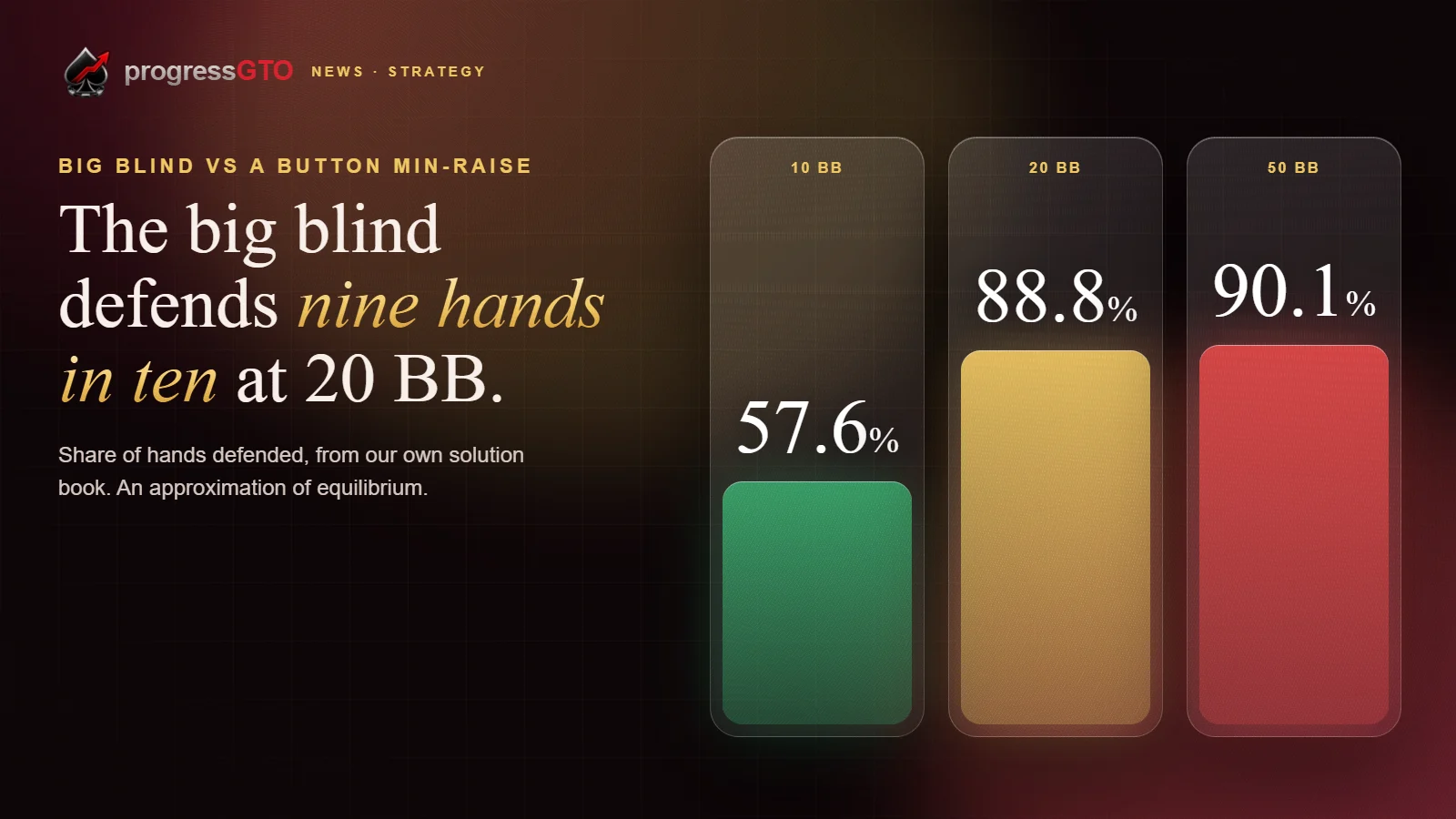
- At 10, 20 and 50 BB the big blind defends 57.6%, 88.8% and 90.1% of hands. progressGTO strategy book
- The all-in share is 19.9% at 10 BB, 24.3% at 20 BB and 0.1% at 50 BB; at 50 BB the raise share is 17.9%. progressGTO strategy book
Still open
- These are equal-stack, chip-EV numbers. Payout structures, bounties and unequal stacks change them.
- The book is our own approximation of equilibrium with a modelled postflop, not an exact solution. It is least certain at the deepest stacks.
- How real opponents raise from the button is not part of the calculation.
How to use this
Start at 20 BB, where the all-in share is highest of the depths we checked (24.3%), and drill the spot until the all-in hands feel natural. Then open the Library, set the stack to 10 BB and to 50 BB, and watch which hands move from all-in to calls or raises.
of hands are defended by the big blind against a button min-raise at 20 BB. Only about 1 hand in 9 folds.Source: progressGTO strategy book, 20 BB, BB against BTN min-raise
Questions readers ask
How often should the big blind defend against a button min-raise?
In our strategy book (8-max, ante from every player, chip EV) the big blind defends 57.6% of hands at 10 BB, 88.8% at 20 BB and 90.1% at 50 BB. It is our own approximation of equilibrium, not an exact solution.
Does the big blind go all-in or call at 20 BB?
Mostly calls. At 20 BB the book calls with 64.4% of hands, goes all-in with 24.3% and folds 11.2%.
What changes at 50 BB?
The all-in is almost gone (0.1% of hands). The book calls 72.1% of hands and raises 17.9%.
Do these numbers hold in every tournament?
No. They assume equal stacks and chip EV. Payout structures, bounties, unequal stacks and how real opponents open from the button change them.