The tip-off
Somebody at the final table is shoving a third of their hands. Somebody else is folding five hands out of six when they are shoved at. If you saw that at your own table you might call it reckless on one side and cowardly on the other. In our ICM library both are what the numbers recommend.
The setup is simple. Nine players, everyone has 10 BB, every player posts the ante, and the prize pool is split by a typical final-table ladder (28/19/13/10/8/7/6/5/4%). Everybody folds to the button. The button goes all-in. The small blind folds. The big blind decides.
The two ranges, side by side
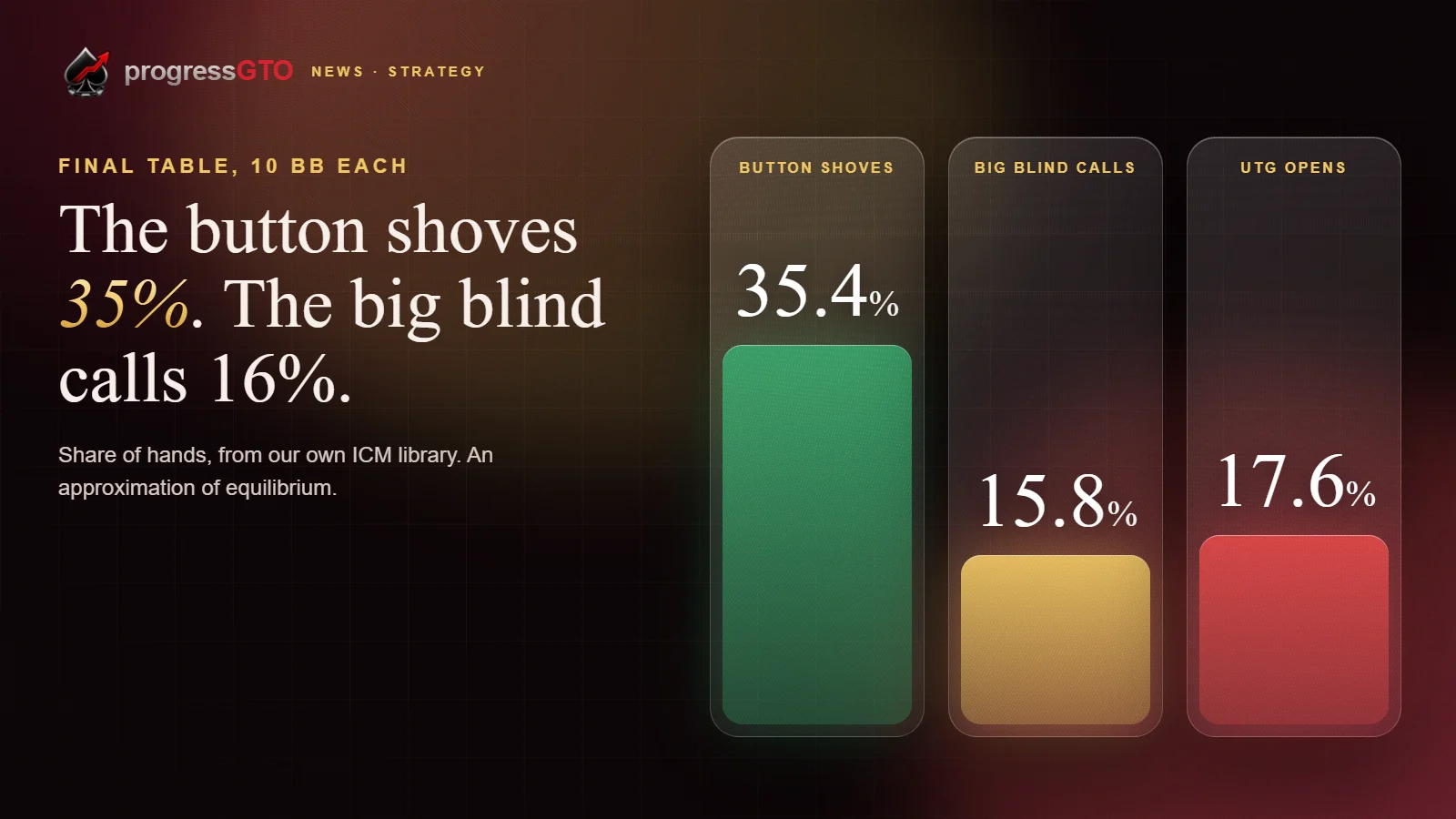
The button goes all-in about 2.2 times as often as the big blind calls (35.4% against 15.8%). For comparison, the first player at the table, who has eight players left to act behind, opens with 17.6% of hands at 10 BB in our strategy book. The button, with only the two blinds left behind, is more than twice as loose.
Why the button is allowed to be greedy
On the button only two players are left to act behind you: the small blind and the big blind. Each of them has to find a hand good enough to fight for a pot where they have already put in some money. Most of the time they do not, and you collect the blinds and the antes without a showdown. A shove that works often enough does not need a strong hand.
That is the whole gossip. The button is not brave, it is in the best seat to steal. When it is called it can lose its whole stack, but the call comes rarely enough that the shove still pays.
Why the big blind is not a coward
The big blind faces a different bet. A call risks all 10 BB. If it loses, the player is out in ninth place and receives 4% of the prize pool. If it wins, it doubles, which is worth something but nowhere near double the prize. On a ladder like this the loss hurts more than the win helps, and ICM is the name for that asymmetry.
So the big blind calls 15.8% of hands against a shove from a player who is shoving 35.4%. It does not fold because it is scared. It folds because its hand is not strong enough to justify the risk of losing the seat.
The same table, a different ladder
The plot thickens when the payouts change. We ran the same spot on five ladders. The big blind calls 5.1% on a very flat ladder, 12.4% on a flat one, 15.8% on the final-table ladder, 18.7% on a top-heavy one and 20.7% on a steep one. The button shoves 94.1% on the very flat ladder, 36.8% on the flat one, 35.4% on the final-table ladder, 34.1% on the top-heavy one and 37.3% on the steep one.
Notice the very flat ladder: the button shoves 94.1% of hands there. That is a quirk of our model with a ladder where first place pays only 9 points more than ninth. We would not take it as advice for a real tournament without checking it against your own payouts.
What this does not say
Confirmed
- With nine equal 10 BB stacks and the final-table ladder, the button's all-in range is 35.4% of hands and the big blind's calling range against it is 15.8%. progressGTO ICM library
- The first player to act opens with 17.6% of hands at 10 BB in the chip-EV strategy book. progressGTO strategy book
Still open
- This is one calculation about ranges, not a statement about how any real player behaves.
- Equal stacks only. A real final table has a short stack and a chip leader, and both change who should shove and who should call.
- The 17.6% for the first player comes from the chip-EV book, the other two numbers from the ICM library, so the three bars are not a perfectly like-for-like comparison.
- The library is our own approximation of equilibrium, not an exact solution, and it does not include bounties or the habits of real opponents.
What to do with the gossip
If you are on the button at a short-stacked final table and everybody folds to you, the numbers say to shove a lot more hands than feels comfortable. If you are in the big blind and somebody shoves, the numbers say to fold most hands and keep your calls for the strong ones. Both feel wrong at first, which is the reason to practise them.
Open the trainer, set the stack to 10 BB and play the big blind against an all-in. Then open the Library and look at the button's all-in range for the same stack.
of hands: the button's all-in range against the big blind's calling range, with nine equal 10 BB stacks and a final-table ladder.Source: progressGTO ICM library
Questions readers ask
How many hands should the button shove at a final table with 10 BB?
In our ICM library, with nine equal 10 BB stacks, ante from every player and a final-table ladder of 28/19/13/10/8/7/6/5/4%, the button goes all-in with 35.4% of hands when everyone folds to it. It is our own approximation of equilibrium, not an exact solution.
How many hands should the big blind call against that shove?
In the same calculation the big blind calls with 15.8% of hands.
Why is the big blind's range so much tighter than the button's?
The button has only two players left to act behind it and wins the blinds and antes when they fold. The big blind has to risk its whole stack and its place in the tournament to call. On a final-table ladder, losing costs more than winning gains.
Does this apply to every final table?
No. It assumes equal 10 BB stacks and one payout ladder. Unequal stacks, other ladders and real opponents change the ranges.