How it started
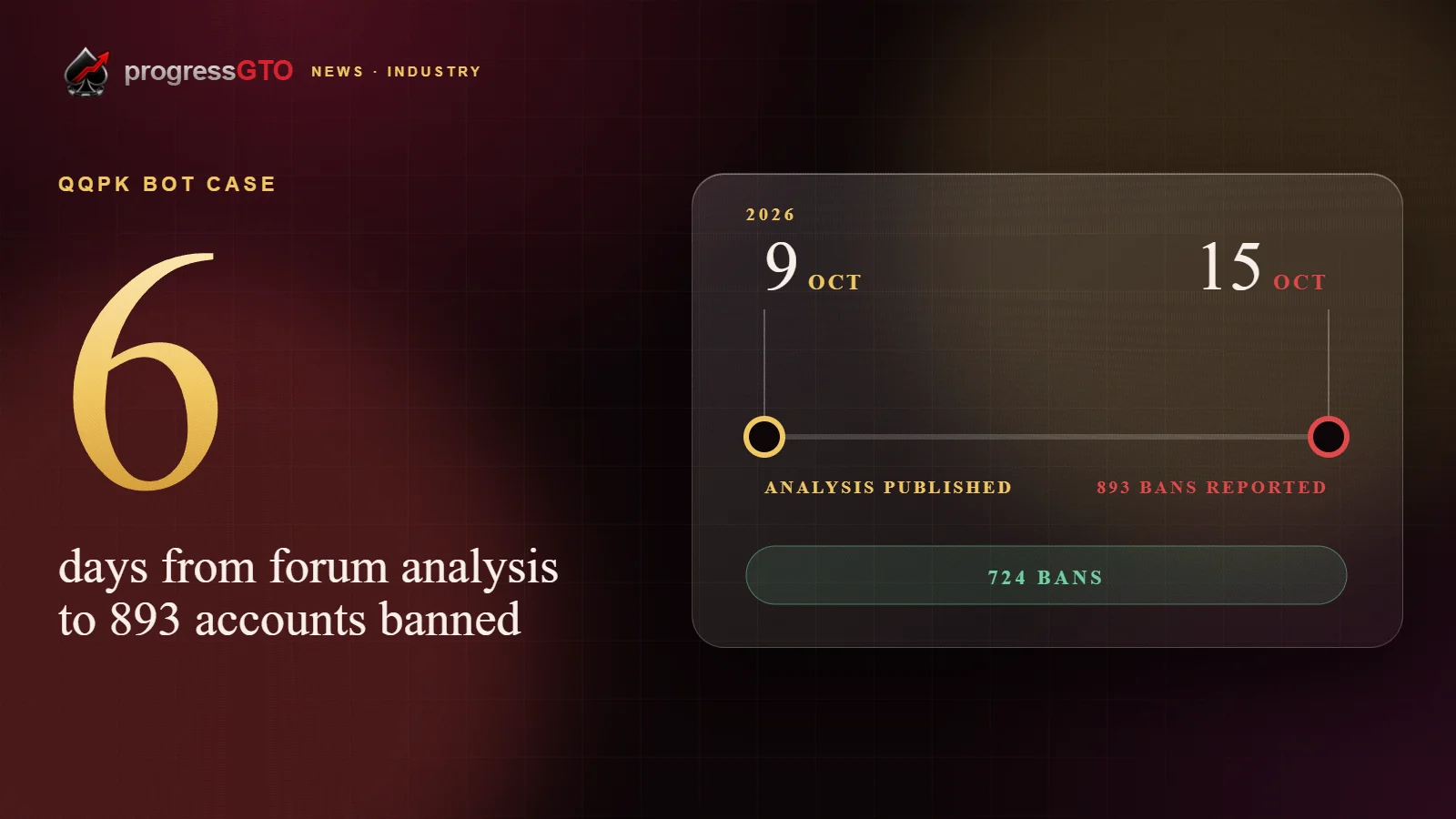
On 9 October 2026 a group of players posted an investigation on the Two Plus Two forum into multi-table tournaments on QQPK. They examined about 26 million player hands from nearly 28,000 tournaments played between 2 July and 2 October, and flagged 2,587 accounts. The flags rested on similar statistical profiles and on results in all-in situations that were far above what the cards would give.
According to the analysis, as reported by Spade Poker, the flagged accounts finished about 138,705 big blinds above their expected equity across roughly 194,000 all-ins, a gap the authors put at 14.6 standard deviations. This is the authors' own calculation and it has not been independently checked. The authors also said they were not claiming that the operator was involved.
What the room did
On 10 October QQPK announced its own server-side review and restricted withdrawals for the flagged accounts. On 13 October it said it had permanently banned 724 accounts for unauthorised automated play. By 15 October the number was 893: 567 from the players' list and 326 found by the room's own team. A further 2,020 accounts stayed under monitoring, which the room said showed no direct cheating patterns.
QQPK also said it set aside a 300,000 dollar compensation fund, of which 64,627 dollars came from the banned accounts and the rest from the room. It said players who took part in its multi-table tournaments in the previous three months would be eligible. A post by the room on 17 October said eligible players would be credited automatically on 20 October. We found no report confirming that the payment was made.
What the room says about cheating
In its update of 15 October QQPK described a coordinated group using several accounts at the same tables to share hole-card information, which it said explains the abnormal all-in results. It said part of the statistical deviation came from millions of duplicated hand records in the external dataset, and that it found no evidence of random number generator manipulation, backdoor access or any ability to see hidden cards. It pointed to its generator's certification by Gaming Laboratories International and offered anonymised hand data for outside review. It also acknowledged that its risk controls had not caught the activity sooner and apologised. All of this is the room's own account.
A second claim, much larger
PokerOrg reported on 15 October that a researcher known as a bot hunter, Vojtech Cervinka, published a list of 11,469 account names on QQPK that he said he was virtually certain were bots. He says he studied about 24 million hands between 16 July and 11 October and estimates that over 70 percent of them were played by bots. He also reports that the same filters found no bot-like players on PokerStars, which he says does not prove there are none there. PokerOrg notes that his classifications are his own and that it is unclear how many of his accounts overlap with the room's bans. A figure of about 12,000 bots in circulation comes from a post by another person, not from him.
What is confirmed and what is not
Confirmed
- Players published an analysis on 9 October 2026 flagging 2,587 QQPK accounts, and the room banned 724 and then 893 accounts. SoMuchPoker; PokerStrategy; Spade Poker
- QQPK announced a 300,000 dollar compensation fund, 64,627 dollars of it from banned accounts. SoMuchPoker; PokerOrg
- The room says its random number generator is certified and it found no manipulation. PokerStrategy; Spade Poker; SoMuchPoker
Still open
- Whether the bans cover the full problem. The researcher claims 11,469 bot accounts, the room banned 893, and overlap between the two lists is unclear.
- The all-in results. The room attributes them partly to card sharing and duplicated data, and outside experts have not checked this.
- What happens to the 2,020 accounts still under monitoring.
- Whether the compensation was paid and how it was calculated. We found no report after 19 October.
What this means for a player
The case shows how online tournaments are policed in practice: players with large hand databases raise a concern, and rooms respond with bans and statements that outsiders cannot easily check. If you play tournaments online, keep your own hand history, look at your results over a long sample before drawing conclusions about luck, and be careful with rooms that publish no independent audits. Study away from the table is under your control: stack sizes, ranges and the decisions you make before the cards arrive.
permanently banned by QQPK by 15 October 2026 after a player investigation flagged 2,587, according to the room.Source: SoMuchPoker, updated 16 October 2026
Questions readers ask
What happened at QQPK?
A forum analysis of about 26 million tournament hands flagged 2,587 accounts on 9 October 2026. The room banned 724 accounts on 13 October and 893 by 15 October.
Did QQPK admit that bots played on its site?
It said the banned accounts used unauthorised automated play and that a group of accounts shared hole-card information. It denies any manipulation of its random number generator.
How many bots are there?
Unknown. The room banned 893 accounts. A researcher claims 11,469 bot accounts. Neither figure has been independently verified.
Will players be compensated?
The room announced a 300,000 dollar fund for players in recent multi-table tournaments, due on 20 October according to its post. We found no report confirming payment.